Category Archives: Peregrinations

The Pennines

The Pennines are the backbone of England, stretching up to the border of Scotland. I feel they are also in my bones: from the back window of the house where I was brought up you could see Kinder Downfalls at the southern end of the Pennines in the Derbyshire Peak District. The dark mass of Kinder Scout was a constant presence in my early life; (more…)
Posted in Peregrinations | Tagged | 2 Comments

Cantal and Devon

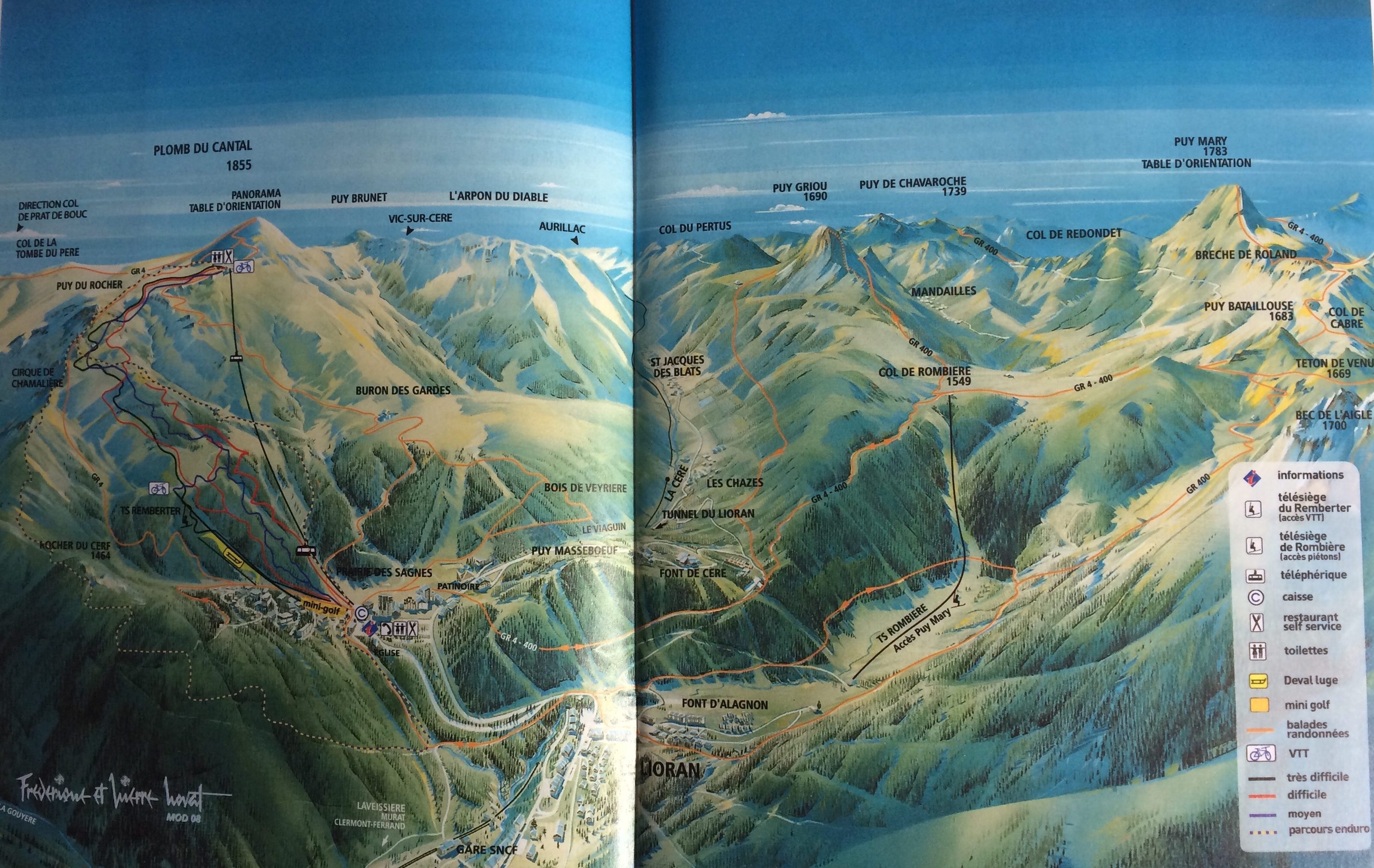
In June we spent five days walking in the Cantal region of the Auvergne.

This plan shows the peaks

A beautiful region popular for walking with the French but little known here in Britain. We met an American couple, Linda and Curt, who were walking a similar route; they come to Europe every year to enjoy a walking holiday and asked if we could recommend any good walks. I thought of the Devon coast-to-coast

A sign at the beginning of the Devon Coast-to-Coast points the way.

which we walked last year, 2017;

and although the moors and farms of Devon are very different from the ancient volcanic landscape of the Cantal, with its steep peaks and narrow ridges, it occurred to me that the two regions have much in common. (more…)

Posted in Peregrinations, The English Tradition | Leave a comment

Returning home to Ilam

The walk we undertook in June – all 250 miles of it – was circular: while not describing a perfect circle, we ended up in Settle where we had started three weeks previously. In August we joined my brother and his family in Dovedale for a much shorter walk that nevertheless completed a large circle; we were bringing the remains of my mother back to the place where she had been born nearly ninety years before. (more…)

Posted in About Cate, Peregrinations, The English Tradition | Leave a comment

Our Pennine Journey

A few years ago, when we walked St Giles Way in southern France, we stayed overnight in a Chambres d’hote and the next day our host gave us a lift to the start of the day’s walk. He was keen to improve his English, so when he wished us a ‘good journey’ we tried to explain that we wouldn’t use the word ‘journey’ for a day’s walk. And yet ‘journey’ seems the obvious term for a day’s occupation coming, as it does, from the French ‘jour’ and having the same root as ‘journeyman’, which originally meant someone who was paid by the day. When walking a long distance, the day’s occupation is to walk to that night’s destination: it is a journey in a very simple sense. Yet now ‘journey’ seems to suggest a trip of some length (more…)

Posted in Peregrinations, The English Tradition | Leave a comment

Around Mont Blanc

There is only one good reason for walking the Tour de Mont Blanc – the experience of the walk itself.  We did what we thought we could manage – anti-clockwise from Courmayeur in Italy, through Switzerland, to Chamonix in France over six days (with the help of the wonderful ‘Enlightened Traveller‘ who organised all the hotels and provided excellent walking notes). There may be some who do the whole tour – and especially those who do the ‘haute route’ – for whom it is another challenge to tick off, but we are no longer at the stage of life when we boast about challenges and adventures. We simply want to enjoy each day and the experiences it brings.  (more…)

Posted in Peregrinations | Leave a comment

Peregrinations and Paths

Beginning of Pilgrimages

The word ‘peregrination’ comes from the Latin peregrinatio meaning a journey through life; a pilgrimage; the act of travelling abroad or from place to place, a course of travel; the condition of living as a sojourner in a foreign land; a systematic going through a subject, writing, course of study etc  It is also the root for the English word ‘pilgrim’.

Pilgrimages remain popular, partly as a way of recovering the past. Recently a group of pilgrims walked from St Paul’s Cathedral, London to Bury St Edmunds, Suffolk, to mark the 1000th anniversary of the returning of St Edmund’s body to the shrine in the Abbey of St Edmund.

(more…)

Posted in Peregrinations, The English Tradition | Leave a comment